
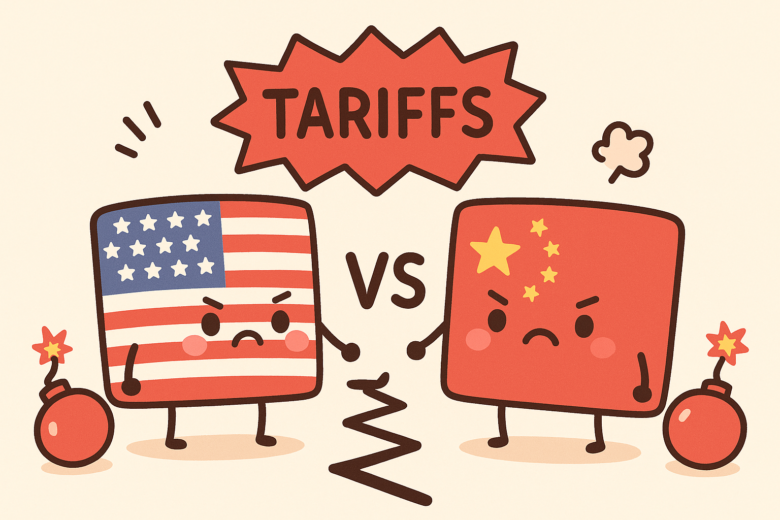
What’s going on with the market whip these days? One day, prices soar due to geopolitical fear; the next they crash in hopes of a truce. It’s confusing, it’s noisy, and it’s still largely focused on the ongoing trade war between the US and China.
Over the past few days, financial headlines have covered a new round of aggressive tariff threats and counter-threats. While the US and China are set to meet soon for talks, their actions this week suggest the trade war is shifting into a higher, more technology-intensive gear.
As a new trader, you need to cut through the noise and understand the basic concept: What is the latest fight about and how has it caused assets like gold to fall just days after hitting record highs?
Here’s a simple breakdown of the latest escalation and what it means for your trading decisions.
What happened this week?
The US-China trade war is no longer just about tariffs; it’s a battle for technological supremacy, and this week was marked by two significant counterattacks targeting critical resources.
Trigger: Rare Earths (early October)
The initial source of tension came from China, which dominates the world’s supply of critical materials, has expanded its controls over the export of rare earth metals and related technologies.
While not exactly “rare” compared to diamonds, these elements are essential components for everything from smartphones and electric car batteries to advanced military equipment. By restricting their export activities, China has shown that it is ready to use its economic leverage to fight back against the trade war.
Payback: Rates and Software (October 20-22, 2025)
The US response came quickly, with two powerful threats from the Trump administration set to take effect around November 1, 2025.
Threat of 100% Tariffs: The biggest headline was the threat of additional 100% tariffs on Chinese goods. This would be added on top of existing tariffs, potentially raising the total duty on some imports to 140% or more.
Software embargo: The main event this week was the news that the US administration is actively developing plans to restrict the global export of products made or containing US software. Since almost “everything imaginable” depends on American software, from laptops to commercial jet engines, this move would lead to a massive escalation and severely disrupt global supply chains.
On the one hand, the US administration is trying to use tariffs and technological controls on exports to reduce the trade deficit and encourage “reciprocal” trade. On the other hand, the Chinese government is using its control over key production resources, such as rare earth elements, as a powerful tool of struggle.
Why it matters
This week’s real-time market reaction perfectly illustrates how geopolitical sentiment drives volatility, especially in storage assets.
A key fundamental driver of market volatility has been the conflict between the fear of escalation (tariff/software ban) and the hope of de-escalation (a potential truce at the upcoming APEC meeting in South Korea).
Market reaction:
Gold (XAU/USD) is down: after hitting an all-time high above $4,380 an ounce on Monday, October 20, it experienced a massive correction. Gold prices fell 5% on Tuesday, October 21, one of the sharpest one-day declines since 2020.
The reversal was prompted by President Trump’s signals that he is optimistic about a “fair” deal coming soon, outweighing fears of the threat of 100% tariffs.
Global stocks: Stock markets often react poorly to trade war threats because of the uncertainty they create for corporate earnings. However, optimism about the upcoming meeting acted as a strong countermeasure, keeping the major indices from collapsing despite aggressive threats.
Key lessons for traders
This week’s events offer several important lessons for those who navigate the markets:
1. Geopolitical hope can overcome geopolitical fear in an instant
Markets often price in the worst case scenario. If there’s even a slight hint that the worst isn’t going to happen, the fear premium quickly evaporates.
Why it matters: Gold’s 5% collapse was not caused by an economic report, but by one upbeat quote about the meeting. As a trader, you must recognize that political rhetoric, especially around trade negotiations, can cause sudden violent reversals in safe haven assets.
2. The main struggle now is related to technology and supply chains
Modern trade wars are aimed not only at consumer goods, but at valuable materials.
Why it matters: The focus on rare earth elements and American software shows that the battle is on to control the technology of the future. This is very important for traders because it makes the technology and industrial sectors very sensitive to any trade news. Watch companies that depend on this specific data.
3. Know the political sensitivity of your currency pair
The USD/CNH pair is a direct gauge of US and Chinese sentiment.
Why it matters: Trading USD/CNH requires understanding that Beijing is actively managing CNH stability. While aggressive threats from the US tend to push the pair higher (a weakening yuan), the political desire for a stable exchange rate ahead of the talks could keep it in a range.
RESULT
This week has confirmed that the US-China conflict is an escalation of a technology trade war that is causing sharp volatility in sentiment. The threat of 100% tariffs and the proposed US software embargo are the two biggest levers currently being used.
For market players, the most important event to watch is the upcoming meeting between President Trump and President Xi in South Korea. The rhetoric surrounding this event will determine whether gold’s recent selloff turns into a trend or just a temporary pause before new highs.
Remember that in a market driven by sudden geopolitical shifts, risk management is your best tool. Keep your position sizes small and never assume that a trend (such as gold’s recent rally) will continue indefinitely as high-stakes political negotiations loom.
Travel Destination
Ekspedisi ke Papua
Pasang Internet MyRepublic
Jasa Import China
Jasa Import China