
Australia’s economy grew by a seasonally adjusted 0.8% in the December 2025 quarter, according to data from the Australian Bureau of Statistics (ABS).
The result was in line with the pace recorded in the June quarter and marked a clear acceleration from the 0.5% expansion in the September quarter. The economy expanded by 2.6% for the year, a significant increase from the sluggish 0.8% annual pace recorded at the end of 2023.
Key takeaways from Australia’s GDP report
- In the December quarter of 2025, GDP grew by 0.8% quarter-on-quarter in chain volume, up from 0.5% in Q3 2025. Annual growth was 2.6%.
- Nominal GDP for the quarter grew by 1.8%.with an implicit GDP price deflator of 1.0%, reflecting stronger domestic prices and a modest improvement in the terms of trade (+0.4%).
- Private and public demand brought 0.3 percentage points each to quarterly GDP growth, while domestic final demand as a whole adds 0.5 p.p.
- Household consumption grew by 0.3%led by discretionary categories including hotels, cafes and restaurants (+1.4%), furniture and appliances (+2.1%) and leisure and culture (+0.8%), boosted by promotional sales on Black Friday and Boxing Day, major sporting events and the school holiday period.
- The savings ratio of the population increased to 6.9% from 6.1% in the September quarter, as growth in disposable income (+1.8%) outpaced growth in nominal spending (+1.1%).
- In 17 out of 19 industries, positive growth of gross added value was recorded in a quarter where mining (+2.6%) and agriculture (+2.5%) lead the goods sector.
- Net trade reduced growth by 0.1 percentage pointas import growth by 1.8% outpaced export growth by 1.4%.
The December quarter benefited from a confluence of factors: a strong agricultural harvest, increased demand for iron ore from China, a surge in domestic tourism tied to major sporting events and concerts, and a long retail advertising period that ran from Black Friday to Boxing Day.
In particular, mining recovered from weather and maintenance disruptions in the previous quarter, while iron ore and coal production increased.
Link to Australian ABS Official GDP (Q4 2025)
Inside the country, the household picture was more nuanced. While spending grew at a modest 0.3%, the sharp rise in the savings ratio to 6.9% suggests that households are rebuilding financial buffers rather than taking full advantage of income gains.
Construction remained the only weak spot among major sectors, falling 0.5% in the quarter as site preparation and heavy engineering activity retreated.
Promotion: Master your trading psychology with AI-powered insights! TradeZella helps you track, test and eliminate bad habits automatically! Click the link and use code “PIPS20” to save 20%!
Disclosure: To help support our free daily content, we may earn a commission from our partners if you sign up through our links at no additional cost.
Market reactions
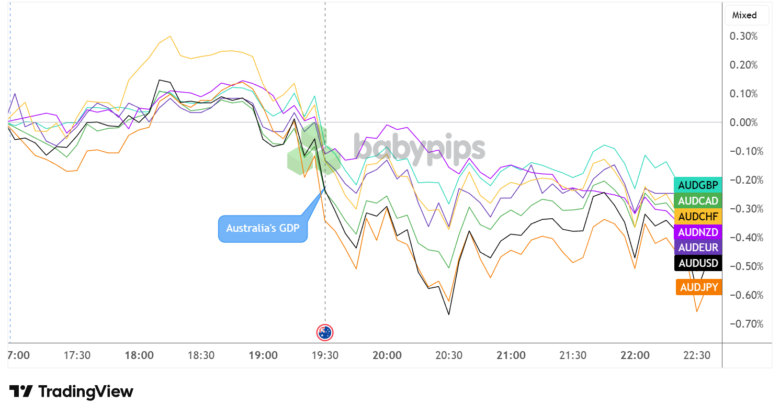
Australian Dollar vs Major Currencies: 5 min
Stacking AUD against major currencies Charts are faster with TradingView
The Australian dollar, which was already down ahead of the GDP release, continued to decline even after the actual results came in better than expected.
AUD/JPY took the brunt of the selling, falling around 0.55-0.65% from pre-release levels and continuing to decline throughout the session, at one point approaching a 0.65% loss. The Aussie saw a more modest fall against the pound and the Canadian dollar by around 0.20-0.30% in a buy-the-rumour, sell-the-news reaction.
During the Asian session, the Australian currency continued to trade below GDP levels despite better-than-expected Chinese PMI data as risk flows from Middle East tensions remained largely in play.
Berita Terkini
Berita Terbaru
Daftar Terbaru
News
Jasa Impor China
Berita Terbaru
Flash News
RuangJP
Pemilu
Berita Terkini
Prediksi Bola
Technology
Otomotif
Berita Terbaru
Teknologi
Berita terkini
Berita Pemilu
Berita Teknologi
Hiburan
master Slote
Berita Terkini
Pendidikan
Resep
Jasa Backlink
Slot gacor terpercaya
Anime Batch