
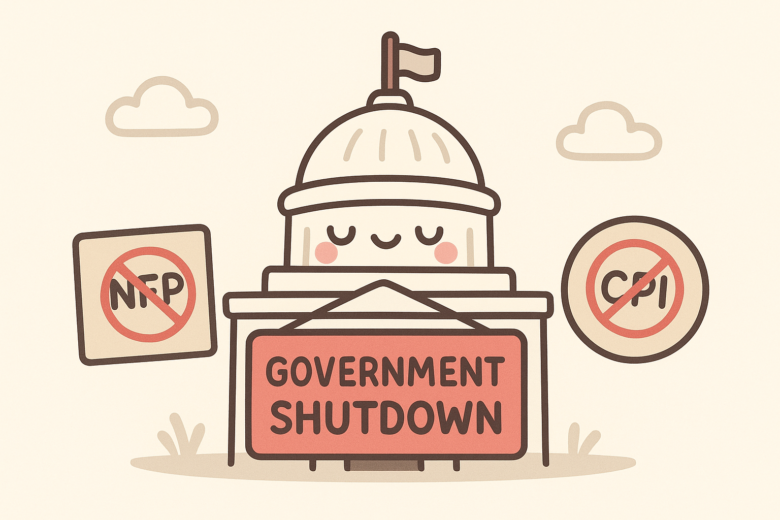
If you’ve been glued to the news this month, you’ve likely witnessed the uncomfortable uncertainty caused by the extended US government shutdown.
Key official releases such as the much-anticipated non-farm payrolls (NFP) report and top-line consumer price index (CPI) inflation data have been delayed by several weeks.
In this “guessing game” of economic data, traders and the Federal Reserve are desperate for accurate information. That’s why a simple monthly survey you might have ignored before can suddenly become the most important number on the calendar: the purchasing managers’ index (PMI).
Understanding the PMI report, why it is a leading indicator and how it is affected by the current political chaos can be critical to protecting your capital and identifying trading opportunities in the coming weeks.
The Basics: What is the PMI Survey?
The Purchasing Managers’ Index, or PMI, is a monthly survey that shows whether a country’s economy is growing or contracting.
Think of it this way: Purchasing managers are the people responsible for purchasing the raw materials, inventory, and services a company needs to operate. They will be the first to know when demand is rising (they need to buy more) or cooling (they need to reduce orders).
Twice a month, private firms (such as S&P Global and the Institute for Supply Management, or ISM) survey hundreds of such managers in the manufacturing and service sectors. Managers are asked simple questions: Are new orders increasing, decreasing, or flat? Is production higher or lower than last month? Are you hiring or firing?
The magic number is 50
The results are crispd into one index number from 0 to 100, and each trader should have one number in mind: 50.
The PMI indicator above 50 means there is a sector expands (grows).
The PMI indicator below 50 means there is a sector shrinking (decreasing).
Reading for 50 funds no changes.
The further the reading is from 50, the faster the rate of expansion or contraction. For example, a PMI of 54.0 signals strong growth, while a reading of 46.0 signals a significant slowdown.
Why it matters: The leading indicator and the blackout effect
PMI is highly valued because it is a leading indicator. This is the key.
Unlike indicators such as GDP (Gross Domestic Product), which tell us about what has already happened, PMIs are designed to look ahead. By capturing changes in new orders and inventories before goods are produced or money changes hands, the PMI often predicts economic swings months ahead of official government data.
Context of the October 2025 shutdown
The prolonged US government shutdown and delayed data leave PMI reports as the only recent glimpse of US economic activity.
- Disable data: The shutdown resulted in the closure of key government agencies such as the Bureau of Labor Statistics (BLS) and the Bureau of Economic Analysis (BEA). This means we don’t know when we will get official data on inflation or unemployment.
- Private data is taken over by: PMI surveys are issued by private organizations (ISM, S&P Global) that are not affected by the shutdown. This means that PMI reports are the only timely, high-quality, and official-like indicator left on the market to measure the health of the US economy.
- Market volatility: The absence of other data sources means that PMI releases will have a much larger impact on the market than usual. Traders will rely on them for clues about future Federal Reserve policy. If the PMI shows a contraction (a reading below 50), it could push bets that the Fed will need to cut interest rates, which would usually lead to a weaker US dollar (USD).
Key lessons for traders
The current economic environment and the sudden importance of the PMI offer several important lessons for new traders:
- Recognize data hierarchy: Not all reports are the same. Understand that leading indicators such as the PMI give you an early look at future trends, while lagging indicators (such as the unemployment rate) confirm trends that are already in place. You can position yourself ahead by observing leading data.
- Context is everything: In normal times, PMI tends to elicit a subdued response. But now, due to the US government shutdown, the PMI has been temporarily upgraded to level 1, an important development. This shift in context means you should expect higher volatility around its release and adjust your risk management accordingly.
-
Follow the sub-indexes: Don’t just react to the PMI headline. Pay close attention to its two most revealing subcomponents:
- New orders: This is the best forward-looking indicator of future demand. A drop here is a strong signal of an upcoming slowdown.
- Prices Paid: This shows what businesses are paying for supplies. High numbers indicate that inflation is rising, something the Fed cares a lot about.
Bottom line
The PMI is a survey of business health that tells you through a 50-point line whether the economy is expanding or contracting. It’s usually one of many indicators, but this time, with the US government shutdown shutting down official data, the PMI has become the market’s main source of truth.
Any big surprise in the upcoming PMI reports, especially a decisive move deeper into contraction (say 47.0 or below), could cause sharp volatility in the dollar and stock market indexes. Always use strict risk management as major news releases can cause massive and sudden price changes.
Disclaimer: The views and opinions expressed in this article are for educational purposes only and do not constitute financial or investment advice. Trading the currency and financial markets involves a high risk of loss, and you should only trade money that you can afford to lose.
Travel Destination
Ekspedisi ke Papua
Pasang Internet MyRepublic
Jasa Import China
Jasa Import China