
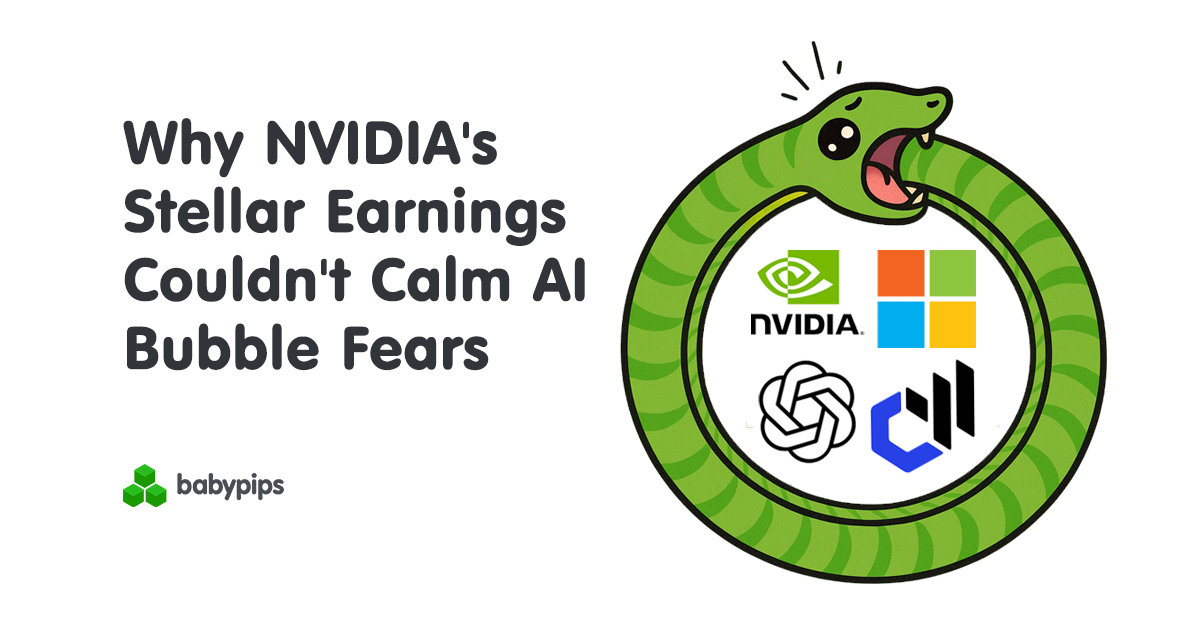
Earlier this week, NVIDIA beat its earnings expectations, posting a big 62% jump in revenue to 57 BILLION DOLLARS year-over-year in the third quarter of 2025, but its shares still fell 3.2% the next day.
What’s up with that?!
Welcome to the paradox that keeps traders up at night: when even impressive gains can’t overcome deeper market fears.
The numbers were worth the dream
NVIDIA’s Q3 2025 results were objectively spectacular:
- The revenue hit 57 billion dollarssurpassing the $54.9 billion mark
- Salary $1.30 per share beat predictions
- The company designed $65 billion for the current quarterwhich is well above the consensus of $62 billion
- CEO Jensen Huang said sales of Blackwell AI chips are “rocking” with $500 billion in backlog until 2026.
By any normal standards, these are incredible numbers. However, shares initially jumped 5% in after-hours trading, only to reverse the next day to close up 3.2%, wiping $140 billion off its market value.
If you’re confused, know that the market does NOT doubt NVIDIA’s success. The market is questioning whether the whole AI boom is sustainable.
A circular money problem
Imagine you lend your friend $100 and he immediately spends $100 buying something from you. Your income looks great on paper, but has real value been created?
This is essentially what happens in AI.
NVIDIA invests significant sums in companies such as OpenAI and CoreWeave. These companies then spend billions to buy NVIDIA chips. NVIDIA and Microsoft invest in Anthropic. Anthropic buys computing hardware from Microsoft Azure that runs on NVIDIA chips.
This “circular financing” sounds eerily similar to the dotcom bubble. Companies like Lucent in the late 1990s lent to telecommunications customers, who then bought Lucent equipment. When customers couldn’t make a profit, the whole house of cards came crashing down.
The difference is that today’s deals involve highly profitable companies like Microsoft and Amazon that are spending huge cash flows, not bad debt.
But the concern remains: Are these deals creating real economic value, or are they just passing money around?
So who is actually making the money?
Here’s the inconvenient truth: NVIDIA is essentially printing money, but the vast majority of those who do use artificial intelligence are not profitable.
A 2025 MIT study found that 95% of enterprise AI developments have yet to turn a profit, despite companies spending up to $40 billion on AI initiatives.
The suppliers (NVIDIA, energy companies, data centers). get richbut customers (AI startups, companies implementing AI). cash flow.
One tech CEO described companies getting “huge valuations without any profit,” relying on “Vibe revenue”—viral enthusiasm—rather than actual sales.
The problem is that when suppliers are the only winners in a gold rush, that has historically been a red flag. After all, customers need to make money or they will stop buying.
A Bank of America survey in November 2025 found that 45% of global fund managers named an AI bubble as the biggest market risk. The Magnificent Seven tech stocks now account for 37% of the S&P 500’s total value.
With such concentration, any crack in the narrative sends shockwaves everywhere.
Why the market “sold the news”.
Several factors likely led to the sell-off following the earnings:
Expectations were sky high
With extreme valuations, you need to exceed expectations, not just exceed them. NVIDIA’s “simply great” results didn’t seem like enough to keep the party going when the dust settled.
Chinese export restrictions
NVIDIA’s CFO noted the frustration of not being able to sell advanced chips to China due to export restrictions – a huge potential market is effectively shut out.
Wider market jitters
Growing fears about Federal Reserve policy, geopolitical tensions and an economic downturn have created a risk-averse mood, with even good news being sold.
Making a profit
NVIDIA is up 42% year-to-date. Many traders took the strong report as a cue to lock in profits.

15-minute chart of Nvidia Corporation on TradingView
By Friday, the sale had gone global. Asian chip names fell, with SoftBank down 10%, SK Hynix down nearly 9% and Samsung down nearly 6%. Even Taiwan Semiconductor, which makes NVIDIA chips, is in the red.
Bitcoin fell below $87,000 after peaking around $126,000, while the S&P 500 fell 1.6% on Thursday after an early 700-point surge. Speculative AI trading unfolded on screen.
Essentially, NVIDIA has been hit by the Bitcoin surge, fading hopes of a Fed rate cut, tightening financial conditions, and incessant AI chatter. When moods change, leaders are the first to hit.
Key lessons for traders
Markets trade the future, not the past: NVIDIA’s third quarter was impressive, but what matters to traders is what’s next. When uncertainty about the future outweighs confidence in the present, stocks can fall on good news.
The “sell news” phenomenon: It’s a classic pattern – anticipation drives prices up before an event, then reality (even a good reality) triggers a selloff. “Buy the rumor, sell the fact.”
The risk of concentration is real: With NVIDIA representing 8% of the S&P 500, its changes affect everyone’s portfolio. Diversification is not just a buzzword.
Bubble fears create self-fulfilling prophecies: Even if AI isn’t in a bubble, if enough investors believe it is, their selling can put pressure on prices, making others nervous, causing more selling. Market psychology can override fundamentals in the short term.
Bottom line
Revolutionary technologies can pass through speculative bubbles – railroads in the 1840s, electricity in the 1890s, the Internet in the late 1990s. Technology changes the world, but that doesn’t mean every investor makes money or valuations remain rational during the transformation.
As one analyst put it, “The AI revolution is real, but that doesn’t mean every stock is fairly priced.” NVIDIA’s falling profits prove that even the leaders of the revolution are not immune to a reality check.
For novice traders, understanding the difference between business results and market reaction is critical.
You’ll want to watch to see if AI companies begin to generate real profits in the coming quarters, if Big Tech’s $365 billion AI spending pace continues, and how the Fed’s rate policy plays out. These factors will determine whether current AI valuations are justified or overvalued.
Remember: never invest more than you can afford to lose.
In times of uncertainty, even stellar fundamentals can take a back seat. The market can stay irrational longer than you can stay solvent.
Travel Destination
Ekspedisi ke Papua
Pasang Internet MyRepublic
Jasa Import China
Jasa Import China