
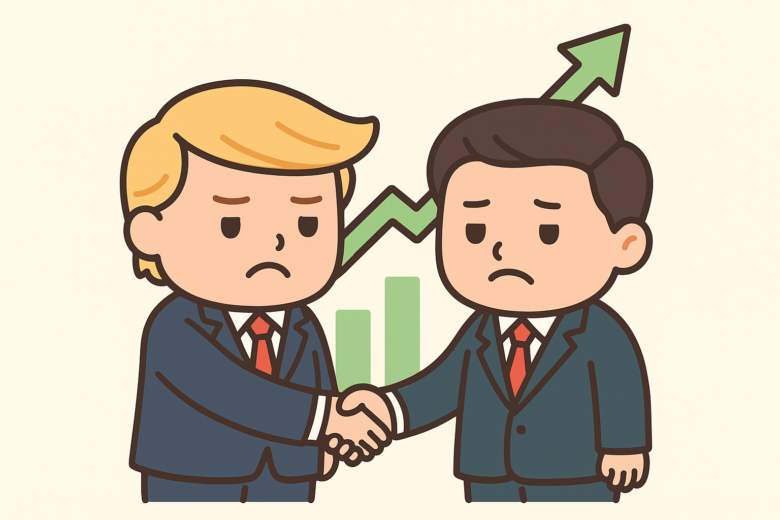
Wondering what’s going on with the risky rallies earlier this week? Stock indexes soared to all-time highs on Monday, while safe-haven gold fell and the weaker dollar weakened.
Welcome to what’s happening as the world’s two largest economies step back from the brink of a full-blown trade war.
Read on to find out what happened between the US and China over the weekend, why it matters, and how markets are reacting to easing geopolitical tensions.
Basics: What happened in Malaysia
Unless you’ve been living under a rock, you’re probably aware that the US and China have been in escalating trade tensions since earlier this year, with tariffs reaching 145% on Chinese goods and 125% on US goods at their peak.
The situation became particularly acute a few weeks ago when China tightened controls on exports of rare earth minerals, which are critical materials used in everything from smartphones to electric cars and military equipment.
In response, President Trump imposed additional 100% tariffs on Chinese imports, set to take effect on November 1. If implemented, it would be economically devastating for both countries.
But this weekend’s talks changed course. US Treasury Secretary Scott Besant and Trade Representative Jamieson Greer met with Chinese Vice Premier He Lifeng and chief negotiator Li Chenggan. And after what Li called “very intensive consultations,” the two sides reached a preliminary consensus on several key issues.
Here’s what they agreed on:
- Tariffs removed: 100% tariff increase will not take place on November 1
- Delay for rare earth minerals: China to delay extended export licensing regime for rare earth minerals for one year
- Soy purchases: China to resume ‘significant’ purchases of US soybeans after not buying soybeans since May 2025
- Extending trade truce: The current tariff pause is likely to continue beyond its Nov. 10 expiration
- TikTok deal: Finalized details to transfer TikTok’s US operations to US control
- Fentanyl Cooperation: Initial Arrangements to Combat the Flow of Fentanyl Precursor Chemicals
Trump and Chinese President Xi Jinping are scheduled to meet on Thursday, October 30, in South Korea to finalize the details.
Why it matters: Market reaction tells the story
As heightened trade tensions ease, markets move quickly. Here’s what happened on Monday, October 27:
Shares rose: The S&P 500 rose about 0.8-0.9% in early trade, pushing to new all-time highs. The index is now up 83.8% since its October 2022 low. Tech stocks, which are particularly sensitive to US-China tensions, led the gains.
USD weakened. The US dollar index (DXY) hovered around 99.00, retracing earlier gains as “risk-on” sentiment strengthened. The dollar has been under pressure all year, falling almost 9% since the beginning of the year – the sharpest drop in three years. When traders are optimistic about global growth, they usually sell dollars to buy riskier assets in other currencies.
Gold fell. Spot gold fell 3.2% below $4,000 an ounce, continuing what Bloomberg called “the worst rout in a decade.” After hitting a record high of $4,381 on October 20, gold fell by more than 5%. why? Gold is a safe-haven asset. As geopolitical risks recede and stock markets rise, traders dump gold in search of higher returns elsewhere.
This pattern (stocks up, gold and dollar down) is textbook “risky” behavior. This suggests that traders believe that the biggest near-term threat to the global economy (a full-scale trade war between the US and China) is receding.
What these moves tell us about positioning
Markets are forward-thinking machines. They don’t react to what’s happening—they react to where things are going. Monday’s price action reveals three things about how traders are positioning:
1. Risk appetite is back
Money flowed out of safe havens (gold, bonds) into riskier assets (stocks, cryptocurrencies). Bitcoin has risen along with stocks. The VIX volatility index, often called the “fear gauge,” fell to multi-month lows. This tells us that traders are betting on economic stability rather than shocks.
2. The sell-to-America trade is suspended
The dollar’s weakness throughout the year reflects concerns about US policy uncertainty and the economic impact of tariffs. But the dollar’s muted reaction on Monday suggests traders are not yet convinced the deal addresses underlying structural problems. They are waiting to see if Trump and Xi will actually sign something concrete on Thursday.
3. Growth expectations are improving
When tariffs are reduced and trade flows increase, corporate profitability improves and GDP growth typically accelerates. The stock market rally, particularly in trade-sensitive sectors such as technology and industrials, suggests traders are anticipating higher earnings.
Bottom line
The breakout of the US and China over the weekend is undeniably positive for the markets in the near term. Stocks are rising, volatility is falling, and the risk of economic disaster from a full-scale trade war has diminished. For traders, this is a classic “risk-on” environment, with stocks and bullish assets outperforming.
But keep perspective. This is ONLY the basis, not the final deal. Trump and Xi have yet to meet on Thursday in South Korea and agree on specifics.
In addition, China has not yet officially confirmed the meeting, although this is typical Beijing protocol. Also, rare earth delays are only for one year, not permanent. Soybean purchases are “significant” but not quantified. Details of the TikTok deal remain vague.
Watch these key events:
- October 30, Thursday: Meeting between Trump and Xi at the APEC summit in South Korea
- November 1: Trump’s original 100% tariff threat deadline (now rejected)
- November 10: Current end of trade truce (likely to be extended)
Monday’s market reaction tells us that traders are feeling relieved and optimistic. But savvy investors know that structures can break down, politics can intervene, and implementation is always more difficult than negotiation.
This deal reduces tail risk (aka the worst-case scenario) but does not eliminate the fundamental strategic competition between the world’s two largest economies.
As always with major market-moving events: celebrate the wins, but manage the risks. The path from structure to execution is never as smooth as Monday morning traders hope.
Travel Destination
Ekspedisi ke Papua
Pasang Internet MyRepublic
Jasa Import China
Jasa Import China