
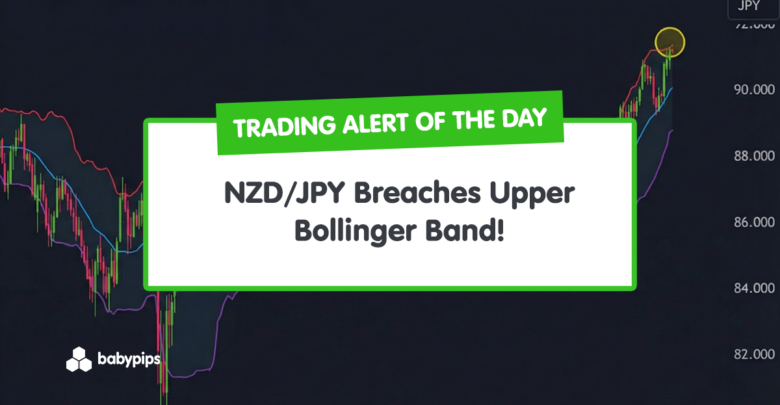
NZD/JPY closed outside of its normal recent range, suggesting that it may have moved too far too fast.
This development followed a steady multi-week rise from the mid-80s to the early 90s.
Traders watching for signs of momentum fatigue or a pullback may find this upper Bollinger band breach particularly noteworthy.
What MarketMilk found
NZD/JPY closed slightly lower at 91.242500 above the 20-period upper Bollinger bandwhich is currently around 91.241696.
This follows a previous close at 90.962500 when the upper band was around 91.283627, indicating that price has now “caught up” and moved through the band as volatility expanded.
This signal appears in the context of a sustained uptrend from nearby lows 85.5–86.0 seen in late September and early October, with recent resistance forming around 90.5–91.0 square meters.
There was a couple horse riding the upper half of the Bollinger Bands since late November, with price repeatedly retesting and respecting the upper band until the last close above it.
What does it signal
This is traditionally indicated by a close above the upper Bollinger band after a sustained advance the price may enter a phase of excessive momentum.
For NZD/JPY, this could attract waiting traders means going back to the middle lane (around 89.99), especially if the price is now trading well above the recent consolidation zone nearby 89.5–90.0.
If a move above the lane fails to build a following, this violation often marks an area where the upward momentum slows and a corrective or sideways price action may develop.
However, this same pattern can also present strong continuation of the trendwhere prices briefly break out of range as volatility expands in the direction of the prevailing trend.
With a solid uptrend, NZD/JPY could “go in a group,” hugging or repeatedly closing near the upper band while moving higher, turning what looks like an overstretch into a prolonged bullish phase.
In such cases, if you allow an immediate reversal, you may face a grind higher than your position!
The result largely depends on how the price behaves around the upper band in the next few sessions and broader risk sentiment weighing on the NZD and JPY.
Context and confirmation important: whether this turns into a top area or just another rung in the uptrend will be revealed by the next candles, reactions around 90.5-91.0 and how quickly the price will (or won’t) return back to the mid-band.
How it works
Bollinger bands is a volatility-based indicator constructed from a moving average (middle band) and two outer bands plotted a given number of standard deviations above and below that average.
In this case, the 20 period moving average for NZD/JPY is currently around 89.985875 with an upper band of 91.241696 and a lower band of 88.730054.
When price touches or crosses the outer bands, it indicates that the move is relatively large compared to recent volatility, often highlighting a potential overstretch or the start of a volatility expansion.
Important: Bollinger Bands measure volatility, not direction. A breakout of the upper band does not guarantee a reversal; in strong uptrends, the price can stay near or above the upper band for a long time.
Bollinger Bands signals are generally more informative in conjunction with trend analysis, key support/resistance levels, and other tools (such as the momentum oscillator or price action patterns), rather than being used in isolation.
What to pay attention to before acting
Don’t assume an immediate bearish reversal.
Consider the following factors:
- Watch for price action – NZD/JPY prints rejection candles (long upper wicks) or bearish close inside the band in the next 1-3 sessions?
- Distance to the middle lane – How fast and how far does the price go back to the 20-period moving average around 90.0 or instead stay at around 91.0+?
- The context of the trend on the higher timeframe – On the weekly charts, is NZD/JPY at a major resistance zone or is it still in an average trend with a place above recent highs?
- Support and resistance are nearby – Watch how price reacts to recent swing highs around 90.8-91.2 and previous support in the 89.5-90.0 region.
- Volatility behavior – Does the band width continue to widen (supporting a strong trend) or is it starting to contract again (supporting a cooling movement)?
- Pulse indicators – Does RSI or Stochastic (if you use them) indicate overbought momentum or bearish divergence from new price highs?
- Cross assets and macro context – NZD tends to be supported in risk-on conditions, while JPY often strengthens in risk-on conditions; How does this move align with broader stock and bond market sentiment?
- Upcoming fundamental events – Watch for New Zealand and Japan economic data releases and central bank announcements that could change volatility or trend direction.
- Session time and liquidity – Pay attention to whether the signal was during the main sessions (Tokyo, London, New York) or outside of them, as liquidity can affect the reliability of range violations.
Risk considerations
⚠️ Risk of false reversal. A breakout of the upper band can lure traders into early countertrend positions only for the uptrend to resume and the price to continue to “follow the band.”
⚠️ The risk of widening volatility. Increased volatility after a range breakout can lead to larger than expected swings, potentially reaching stops on either side before the direction becomes clear.
⚠️ Mismatch of terms. Signals on this time frame can conflict with longer-term trends on the weekly chart, causing trades not to follow the dominant trend.
⚠️ Outbreaks caused by news. Sudden macros or policy surprises affecting the NZD or JPY can redefine technicals, turning a seemingly clean streak into a sharp continuation.
Potential next steps
Consider adding NZD/JPY to your watchlist to watch the price behave around the upper Bollinger band over the next few sessions.
You can wait for clarity confirmationsuch as a strong retracement inside bearish candlestick bands, or alternatively, strong closes holding above recent highs before acting on a potential reversal or continuation scenario.
Whatever your approach, put any trading ideas in the context of higher timeframes and use disciplined risk management, including pre-defined stop-loss levels and position sizing that takes into account current volatility.
Situs Informasi Kunci Jawaban PR semua Mata Pelajaran
Kunci Jawaban PRNews
Berita Teknologi
Berita Olahraga
Sports news
sports
Motivation
football prediction
technology
Berita Technologi
Berita Terkini
Tempat Wisata
News Flash
Football
Gaming
Game News
Gamers
Jasa Artikel
Jasa Backlink
Agen234
Agen234
Agen234
Resep
Cek Ongkir Cargo
Download Film
kunci jawaban
kunci jawaban brain out
kunci jawaban tebak gambar
kunci jawaban tema
kunci jawaban halaman
kunci jawaban tema 1 kelas 5
kunci jawaban tema 1 kelas 4
kunci jawaban tebak kata shopee
kunci jawaban tebak gambar level 8
kunci jawaban tebak gambar level 9
kunci jawaban matematika kelas 5
kunci jawaban tebak gambar level 4
kunci jawaban tebak gambar level 6
kunci jawaban tema 1 kelas 6
kunci jawaban matematika
kunci jawaban matematika kelas 5 halaman 75
kunci jawaban tebak gambar level 7
kunci jawaban kelas 5
kunci jawaban tema 6
kunci jawaban tema 5
kunci jawaban kelas 4
kunci jawaban tts
kunci jawaban tema 2
soal ujian kelas 6 2022 dan kunci jawaban
kunci jawaban kelas
kunci jawaban tebak gambar level 5
soal matematika kelas 5 pecahan dan kunci jawaban
kunci jawaban tema 2 kelas 5 halaman 16
kunci jawaban matematika kelas 6
kunci jawaban brain test
kunci jawaban tebak gambar level 10
kunci jawaban tema 2 kelas 6
kunci jawaban tema 9 kelas 5
kunci jawaban tebak gambar level 11
kunci jawaban tema 4
kunci jawaban tebak gambar level 3
kunci jawaban tema 2 kelas 6 halaman 3
kunci jawaban tema 3
kunci jawaban tema 2 kelas 5 halaman 54
kunci jawaban tema 1
kunci jawaban tebak gambar level 12
kunci jawaban matematika kelas 4
kunci jawaban kelas 3
kunci jawaban wow
kunci jawaban tema 3 kelas 5 halaman 23
kunci jawaban tebak gambar level 13
kunci jawaban tema 6 kelas 5 halaman 71
kunci jawaban buku tematik kelas 4 tema 1 indahnya kebersamaan
kunci jawaban tema 2 kelas 6 halaman 27
kunci jawaban tema 2 kelas 4